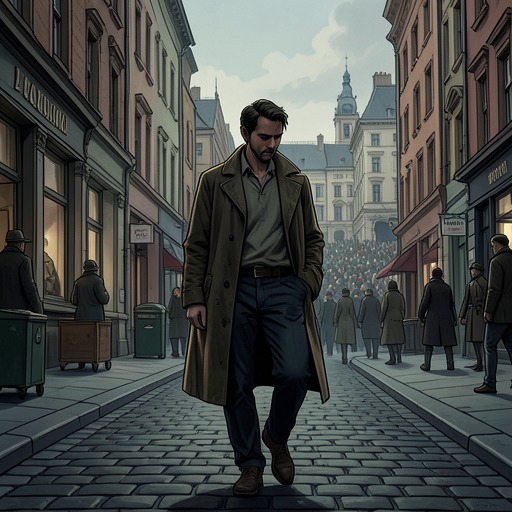
John retreats to the lighthouse
Brave New WorldJohn retreats to the lighthouse after Mustapha Mond refuses his request to accompany Bernard Marx and Helmholtz Watson to the islands. The withdrawal is both a protest against being treated as an experiment and an attempt to secure the solitude he believes he needs; at the tower, however, isolation becomes a demanding religious discipline, and even the beauty of the place seems to him something he must suffer to deserve.
Refusal of the Experiment
John tells Helmholtz that he went to see Mustapha Mond to ask whether he might go to the islands with him and Bernard. Mond refuses, explaining that he wants to continue the experiment. John responds with sudden anger: he will not go on being experimented with, regardless of what the Controllers want. He decides that he, too, will leave the next day.
The others ask where he will go. John cannot name a destination and says that he does not care where, provided that he can be alone. His answer makes solitude the purpose of his departure, rather than a step toward joining another community or finding a new position within the World State. Mond's refusal has made the choice stark: John will leave the setting in which he is being observed, even though he has no settled plan for what comes after.
The Lighthouse as Hermitage
John chooses an old air-lighthouse on a hill between Puttenham and Elstead. The surrounding air routes give the site a history of altered traffic: the old Portsmouth-to-London route is marked by four abandoned air-lighthouses, while helicopters now roar over a redirected corridor. His chosen tower is therefore both a remnant of an earlier route and a place apart from the busy skies of the present.
The building is made of ferro-concrete and is in excellent condition. Its comfort unsettles John; when he first explores it, he considers it almost too luxurious, too civilized for a hermitage. He reconciles himself to living there by promising a correspondingly harsher self-discipline and more complete purifications. The retreat begins not with deprivation imposed by the building, but with John's decision to answer its relative comfort by making hardship for himself.
The First Night of Penance
John deliberately stays awake through his first night in the lighthouse. He spends the hours on his knees praying, moving among several religious inheritances: he invokes the Heaven to which the guilty Claudius appealed, prays in Zuni to Awonawilona, and turns also to Jesus, Pookong, and his own guardian animal, the eagle. The prayers draw together traditions that do not resolve into a single, settled practice; the scene instead presents John reaching across them in search of purification.
At intervals he stretches out his arms as though crucified and holds them there until the growing ache becomes excruciating. Sweat pours down his face as he repeats his plea for forgiveness, purity, and goodness, continuing until pain brings him close to fainting. The vigil converts his announced wish for solitude into physical action: alone in the tower, John makes his body the instrument of the discipline he believes the comfortable surroundings demand.
Beauty, Guilt, and the View
By morning John feels that he has earned the right to inhabit the lighthouse, though the qualification matters. The structure still has glass in most of its windows, and its elevated platform offers a fine view. The very reason he chose the place now troubles him: its beauty feels like an undeserved indulgence. He had selected it because the view seemed to show the incarnation of a divine being, but he questions whether he deserves to live in the visible presence of God. In his judgment, a filthy sty or a blind hole in the ground would better match what he merits.
Still stiff and aching from the night, but inwardly reassured by the ordeal, John climbs to the platform and looks out at the sunrise. The landscape presents a contrast between the natural prospect and the signs of the modern settlement: the long chalk ridge of the Hog's Back bounds the view to the north, and the seven skyscrapers of Guildford rise behind its eastern end. John grimaces at the sight. In time, however, he becomes reconciled to the towers, which at night appear as geometric constellations or, when floodlit, point their luminous fingers toward the mysteries of heaven. The retreat thus begins in rejection, but the view already complicates any simple separation from the world he has left.
Significance of the Retreat
John's withdrawal gives concrete form to two competing needs. He wants to escape the Controllers' experiment and to be alone, yet he also seeks a moral and religious justification for occupying the place he has chosen. Comfort provokes guilt; beauty becomes a privilege to be earned; prayer leads into deliberate bodily suffering. The lighthouse is a refuge from social observation, but it does not free him from judgment: away from the Controllers, John imposes a severe judgment upon himself.
The episode also establishes the physical setting and habits of his hermitage. The abandoned tower offers shelter and a view, while its location between Puttenham and Elstead places John's chosen solitude within reach of a landscape still marked by the World State's roads, air routes, and skyscrapers. His first night sets the terms of the retreat: isolation is not ease, and escape from being an experiment does not end his struggle to decide what kind of life he can accept.